SeaCoast Process
Most compost is finished in ninety days. Ours takes seven hundred and thirty.
Most compost is finished in ninety days. Ours takes seven hundred and thirty.
We don't get paid to accept what anyone brings. We only bring in the finest raw materials available.
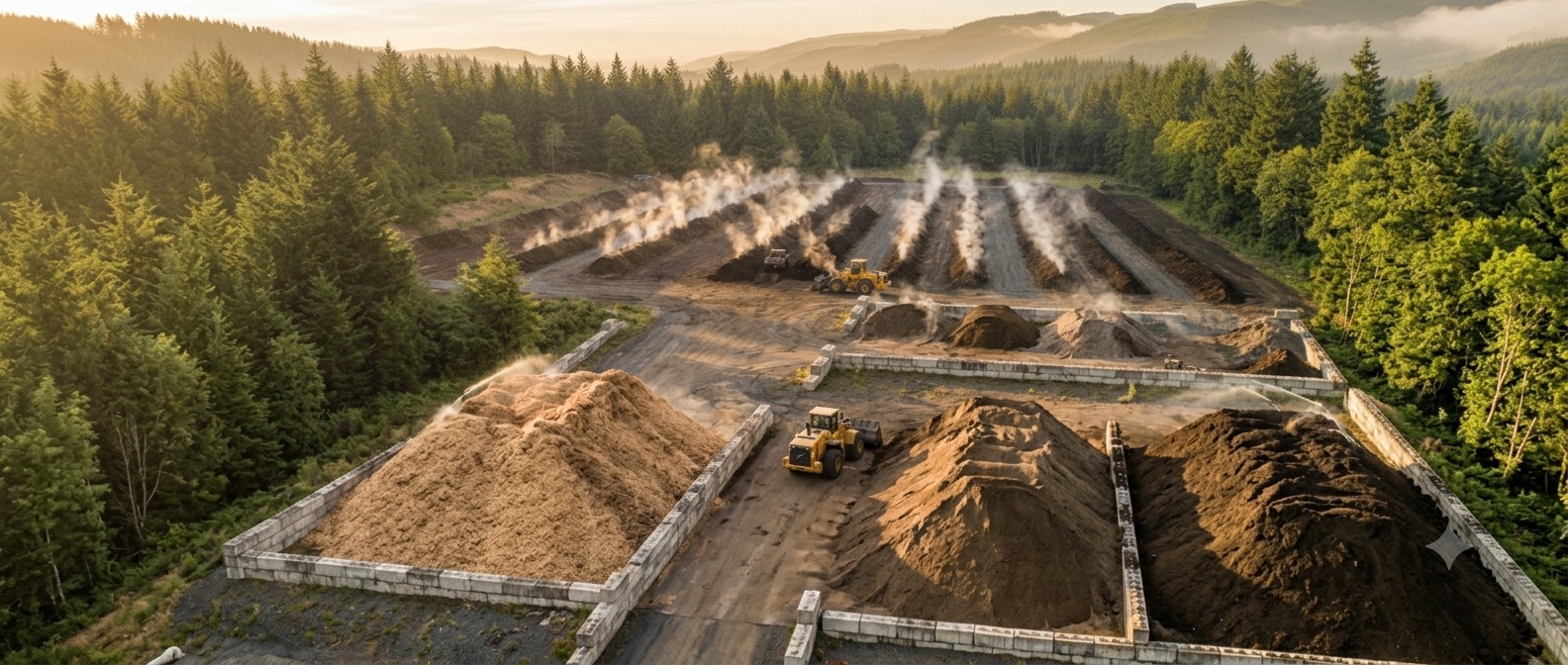
Red alder trees are milled locally and their bark and sawdust are stockpiled on site. Cow manure is gathered from cows grazing on the lush Oregon pastures of our nearby organic dairies. The diverse marine byproduct, Dungeness crab, pink shrimp, and myriad fish species wild caught from our pristine Pacific waters, arrives from the docks after the fishermen have returned and gets directly mixed together.
Every material in this compost is sourced within fifty miles.
Cow manure, alder sawdust, and marine byproduct are combined on the mixing slab in measured proportion before windrows are formed. Getting this right at the start is highly important. A pile built on the wrong carbon-to-nitrogen ratio will either stall or go anaerobic, and no amount of turning afterward fixes it.
Because we handpick our inputs, we take exactly what the ratio requires and nothing extra. It is a costlier way to operate, but it allows us a high level of control over what gets into your garden.
Our loaders form the mixture into windrows that run hundreds of feet. The shape of the pile allows for a healthy balance of oxygen exchange, warmth generation, and moisture retention: the essential elements in aerobic decomposition.
We compost in passive windrows without forced air. No blowers, no injected oxygen. The row breathes on its own through its skin, and we turn the windrow to keep that exchange happening.
It is a slower breathing than forcing air into the pile, but it is a deeper breathing, and it allows us to build a more healthy microbiome.
As soon as the windrow is complete, the biodynamic preparations go in. Six potentized herbal preparations are specially prepared to help plants become more sensitive to their surroundings, helping them take up from the earth and receive from the sun what they need to become vital, adaptable plants.
These preparations are added to the piles in homeopathic doses that inform the decomposition process right from the beginning. Our goal is to create warm, breathing, metabolic piles that digest the dead and dying plant and animal bodies into a substance with latent life-giving qualities.
The first phase of the digestion is active decomposition. Thermophilic bacteria are a dominant presence in this initial phase, helping generate heat that sustains temperatures between 135 and 145 degrees. We turn each windrow in this stage to ensure that everything heats to these temperatures.
After this phase, a second mesophilic stage sets up and a more diverse life moves in: bacteria, fungi, and protozoans all work together to begin to magically transform the materials into raw organic substance.
This stage lasts about a year, through a winter of coastal rain and a summer of coastal fog. Most commercial compost is bagged and sold before it reaches the end of what we consider the first half.
When the temperatures go down, the windrows begin to cure. These cooler habitats invite insects and worms by the billions. As the soil food web moves in and goes to work, the compost goes through another transformative stage.
The second year is ultimately working toward humus: the stable end state of composting, and what ultimately allows plants to achieve a living transfer and flow from soil life to plant life.
The field test for humus is to smear finished compost between your fingers. If it leaves a dark, smooth smudge, you have arrived at humus. If it is grainy or dusty, you are not there yet. Keep going.
We run our finished compost through a fine screen trommel, which takes out anything oversized and leaves a consistent, even texture that spreads cleanly and blends easily into any application.
Then it is tested, bagged or loaded in bulk, and out the door. Two years after it went into the windrow.